Do We Still See “Death” as Death?

Do we still see “death” as death?

In late Sept, early Oct 2020 I started hearing a lot of pandemic talk from politicians about our nation “making the turn” – “going to disappear” – “get back to normal” –  again, all this in relation to the pandemic – I was concerned about this chatter because it was from our nation’s leadership, and it presented positions exactly the opposite of the medical community – why were they not in sync?

Perplexed by this disparity, I dug in (as I do) to attempt to sort out the wheat from the chaff – I was conflicted for several reasons:

  1. I believe politics and medical issues are separate and distinct – I also believe, great care should be taken if ever the two find themselves in the same space – the absence of “great care” could absolutely be reckless, and perhaps criminal behavior on either or both sides.
  • Pandemic numbers and storylines were becoming confusing and inconsistent for me – i.e.
  1. number of tests administered,
  • positivity rate of tests,
  • which tests were more or less effective,
  • number of cases increased and why,
  • death rate of positive cases,
  • causes of spread,
  • prevention of spread,
  • number of deaths,
  1. why is this pandemic better or worse than other pandemics (not sure why that matters),
  • which deaths were actually pandemic related….
  • Our nation’s leaders, and our collective medical community were not able to formulate a consistent collaborated version of basic truths surrounding the pandemic – even as the basic truths were continually evolving (as we learned more), the two messages were just significantly different.
  • We (American’s) were left to decide who to trust, when, in theory, the two entities (Govt & Med Community) should have been in sync – this really frustrated me, and millions of Americans – we elect our state and national leaders – those leaders appoint subject matter experts to run the organizations/agencies which address things like a pandemic – but somehow, this simple process become corrupt and clear/accurate messaging paid the price as confusion/conflict  continues to reign in the land.

Okay, I said all that to point out as this disparity unfolded, ‘we the people’ picked sides, armored up our social medias, and started to launch blame and insult at each other (insert disgruntled face here)  – all the while, I was still very confused and frustrated by the lack of clear/accurate messaging.

So (the point of this rant), I did two simple things to help my (very twisted) mind understand and track a simple and measurable status/condition of the pandemic (for me) – I believe in doing the work, not just following the agendas – so, on 7 Oct 2020 I got to work at sorting this out for me:

  1. I dug deep into what is it that causes a death to be considered pandemic related – BLUF, in the US the death certificate does – there are a great many details and hands associated with this process – I’m not for or against the process, but it’s the same process we had before the pandemic started – plus it gave me a constant data point to measure and track – NOTE: I’ve shared insight about the death certificate a few times, pls let me know if you’d like to see those details.
  • Then I started tracking daily US pandemic related deaths – the other US data points (tests, positivity rates, hospitalizations, etc…) all had external factors to consider whereas, the death of a person is a constant (albeit tragic) – I collected and compared numbers from multiple sources – then I managed that data into a simple trackable format by following these constant process steps:
  1. Pull four daily data sources (US daily pandemic deaths): HHS, CDC, JHU and WHO (numbers were similar but not always the same).
  • Averaged the four daily counts into one daily data point.
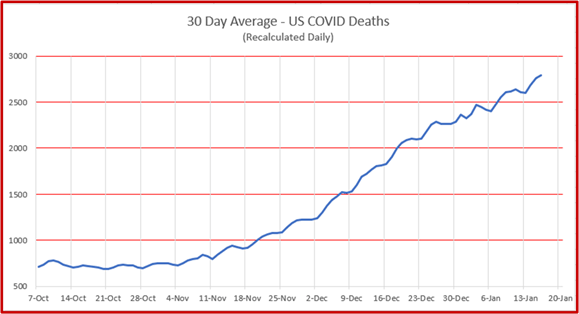
  • Averaged those daily data points into a daily 30-day average, recalculated daily – the 30 day average is significant because daily reporting is very inconsistent (highs & lows) around weekends, holidays and anticipated subtleties of humans – more clearly, 30 averages define trends and trend lines.
  • This sounds like a lot of work, but it is not – MS Excel is the closest thing to magic on the planet today (no disrespect to Harry Potter) – once it is set up (properly), it does the work for you each time you enter the new daily data from four data sources.

Why does any of this matter – because regardless of our political posture, our failed (or unblemished) economic condition, our medical beliefs, or our feelings about the pandemic…

…numbers don’t lie – numbers don’t have political agendas – numbers just paint a picture of reality – and for me, because our Govt and our Med Community are at odds, I desperately wanted to know what was real.

I’ve attached the chart that shows the results of the calculations (outlined above) – everyday, I update the data, and let the chart illustrate what I believe is real.

Hind Sight

Hind sight is so easy, so clear – he was never fit for the position – his uncontrolled lies, heavy handed bully pulpit, & narcissistic demand for unconditional loyalty were apparent early – leaders approached him, which proved to be career ending – his policies had potential, but we learned his policies were secondary to his desire for attention, but mostly praise for himself – conservatives ignored & tolerated his behaviors & the warning signs – he used news & social media to attempt to manage his image as the shine eroded off his self-professed greatness – the worst step conservatives made was shifting from ignoring & tolerating to ‘pretending’ he was a political, economic, and social intellect – this was also the point when the greater conservative base went ‘all-in’ on him, knowing we’d come too far to turn back – shame on all of us who allowed this to happen for political and economic agendas, without consideration of the enormous cost to the nation.

Who Do You Trust?

Who Do You Trust?

Fake news – False agendas – truth or lies – the nation is caught in the emotional crosshairs of picking sides of political agendas, pandemic responsibility, and real social/civil rights issues – appallingly, that’s just some surface level issues – there are many more issues of equal or greater weight.

Tragically, we seem to be leveraging a smorgasbord resources to confirm or deny our positions in relation to these critical issues.

What, or who are these resources we leverage?

Are they credible?

What is our measure of truth or lies these days?

What have we hitched our emotional, political, civil and Spiritual wagons to?

Can we justify our positions, or do we just like the way a particular position sounds to us?

Are we honest with ourselves about some of these issues?

Its too broad of a question to address out right, so I’ll focus on only one (of so many) issues for the purpose of clarity,  “claims of a stolen election” (personal favorite).

I guess if the claims ARE really true, then I agree with those who support the stolen election claims – those making those claims should continue to beat the drum and fight the fight.

However, if those claims are NOT true they should slip quietly back into society – again, only focusing on the claims of a stolen election for the purpose of making a point – this is only one of a hundred issues we truly need to know the truth about.

So, let’s start there – it’s one of the larger questions all Americans need to ask ourselves – are the claims of a stolen election true or false?

The 2020 election is just one of many “straws” breaking (or reinforcing) the backbone of the American people. Each one of these “straws” carry weight, and each one should be thoroughly evaluated/vetted through trustworthy sources – sources we all recognize as being credible.

Please be patient with me, this is a good but very slow point – so here we are, all Americans are trying hard to ascertain truth from lies in an ocean of voices, opinions, agendas, and motives.

I have a few simple rules my kids helped me adopt for “determining truth from lies”:

  1. Don’t trust anyone who makes money from pitching “only one side” of an argument i.e. talking heads, network anything, organizations, etc – their livelihood is pivotal on their ability to draw viewers/followers – truth is not part of their financial gain – hype is their goal, not presenting truth – I’m more inclined to trust sources that unashamedly share multiple sides of an argument.
  2. Don’t trust social media (ever) – seriously, there are few rules which always equals chaos – I’m engaged in 15 to 20 active conversations (similar to this) every week, and I’m shocked at how many Americans (on both sides) who’s only source is social media – that feels lazy, shallow, and reckless to me.
  3. Don’t trust voices or organizations that fund politicians, political agendas, or fund other organizations that do the same – these are clearly agenda driven sources, and there are thousands of them clamoring for our attention.
  4. Don’t trust sources that CANNOT point to “firsthand knowledge” – firsthand accounts of an event are the gold standard – opinions are the first step toward an agenda, and the last step aligned with truth – we learned this hard lesson in Bosnia, Iraq, Kuwait, and Afghanistan.
  5. Don’t trust voices of those in positions of influence (celebrities, business leaders, athletes, etc) who promote “only one side” of an argument – they are not subject matter experts, knowledgeable, and they do not have the best interest of everyday American’s at heart.
  6. Last one – Don’t trust those we entrust in religious, clergy, or Spiritual positions who use their position to pitch political agendas that are NOT tightly tethered to faith based doctrine.

POINT: Reading, listening to or sharing information or positions from any of these 6 warnings is fine – but, we should never fool ourselves into believing they’re a credible source for transparent constant truth.

So, I said all that to ask, reference the claims of a stolen election – would millions of Americans still support this claim of a stolen election if it actually turned out to be proven false?

Remember, we’re not just swinging at nothing and hoping for everything – we have standards of credibility to consider.

If using the above-mentioned standards of credible and trusted sources actually illustrates the claims of a stolen election are proven false…    would we genuinely consider the probability that we’ve hitched our wagon to a false claim? Or would we blindly hold fast to the false claim because it satisfies other aspects of our personal agendas? Please think about this pivotal point before reading on – we all have to honestly ask ourselves about our own beliefs.

This is a big deal because I believe we embrace many of the ideas supports of the “stolen election agenda” offer, but are we turning a blind eye to the real risks associated with that position’s fallout and long-term damage? Are we being honest with ourselves? How much effort are we really applying to peeling that “truth” onion?

For example, recently the Senior Republican Senator (Pat Toomey) from the state of Pennsylvania spoke passionately on the floor of the US Senate, addressing each of claims of a stolen election and systematically debunked each of them – do we give that consideration, or do we ignore it?

If we weigh the Senator’s remarks against our 6 measurements of truth (listed above), then his remarks could easily pass the truth-smell test.

The Senator:

  1. Is a member of the party that supports the stolen election agenda.
  2. Voted for the party that supports the stolen election agenda.
  3. Had a great deal to gain personally, financially, politically, and publicly if he supported the stolen election agenda.

Yet, the Senator did not support the stolen election agenda – curious for sure – or, evidence of truth (your call).

Sen Pat Toomey’s speech is easy to access via public .gov sources – I strongly recommend reading/watching that speech, accessed from a trusted source so you can decide for yourself.

A very similar case could be made for state level leaders (Governor, Sec of State) and elections officials in the state of Georgia who were also:

  1. Are members of the party supporting the stolen election agenda.
  2. Voted for the party supporting the stolen election agenda.
  3. Could have gained (personally, financially, politically, publicly) from supporting the stolen election agenda.

Yet, these leaders did not support the stolen election agenda – again, curious for sure – or, evidence of truth (our call).

If we weigh the positions of the leaders from Georgia against our 6 measurements of truth (listed above), then their positions could also easily pass the truth-smell test.

So, if the claims of a stolen election are proven false, what else is false?

What are we holding fast to that just might be a lie? But we tell ourselves its okay because it fits our personal agendas?

For me, I would prefer a position, agenda, or movement with more credibility, even if that movement does not always line-up well with my personal agendas. (Seriously!)

The stolen election agenda is just one of hundreds of issues that we should know absolute truth about.

Is truth really that hard to determine? Or, are we the only thing keeping us from knowing truth?

Who do we trust?

“Proximity breeds care, and distance breeds fear.”

I heard a wonderful bullet this week in a presentation by Emmanuel Acho:

“Proximity breeds care, and distance breeds fear. Not recognizing this basic principle, leads to not enough care and empathy and heightened amounts of fear.”

Admit it or not, we all carry heavy fears these days – fear of different peoples – fear of political views – fear for the future of our nation – fear of things that are different – and sadly, fear of each other.

I hear so many of us say, “Lord heal our land.” Sadly, many of us miss a major component of trusting the Lord’s will for our lives and any land – maybe, the missing component is obedience – obedience equals behaving in such a way that actually reflects the Lord’s will in our lives – but, we remain set in our ways, distant and fearful.

If all we ever do is invest in the same people who look like us – engage in the same habits and traditions we always have – participate well within our comfort zones, etc., etc… We fail to recognize this basic principle of proximity – by holding fast to our personal comfort instead of proximity, we are compromising care and empathy, and we’re heightening fear (of each other).

Proximity is the easiest, most effective form of healing – proximity is as simple as a hand, a smile, a greeting, or providing assistance – becoming acquainted, investing physically/emotionally, engaging in others rather than ourselves – proximity is the most powerful step we can take, if we truly long for our nation to heal – proximity is a Biblical manifestation of obedience to the Lord’s will in our lives.

What does proximity look like?

Politicians reach across the aisle.

Neighbors walk across the yard.

Coworkers check on each other.

Churches support other churches.

Those that have, help those that have not.

Truly live out the old school “Golden Rule”.

Really get to know and learn more about others – walk the walk, not just talk the talk – be the salt and light to those outside of our normal paths.

Perhaps something like…

“…You are the salt of the earth. But if the salt loses its saltiness, how can it be made salty again? It is no longer good for anything, except to be thrown out and trampled underfoot. You are the light of the world…    …and it gives light to everyone in the house. In the same way, let your light shine before others, that they may see your good deeds and glorify your Father in heaven.”

“Proximity breeds care, and distance breeds fear.”

Are we perpetuating care or fear?

What is the worst of what has become of us?

Jesse (J.C.) Owens – 1936 Olympian won four Gold Medals, has a passage in “The Warmth of Other Suns” by Isabel Wilkerson:

“I wasn’t invited to shake Hitler’s hand. I had to ride a freight elevator to my own reception at the Waldorf Hotel in NY.  And I wasn’t invited to the Whitehouse to shake the President’s hand.”

You and I know the Jesse Owens’ story because he was a famous and extraordinary Black Olympian – the inequality, the racism, the appalling illustration of the Owen’s story is horrifying, and we are all aware of it.

What is even more horrifying are multiple hundreds of thousands of stories like his from the past hundred years – stories of less know Americans that caused terror, fear, and inhuman existence to millions.

Stories from right here in America – stories that occurred thousands and thousands of times – stories of the most grotesque and violent nature – stories that dehumanize and brutalize countless numbers men, women, and children – stories that scarred and shaped the hearts and heads of many generations of Americans.

In each story, there are always victims and there are always those who victimize others.

What’s the point Kevin – what happened (and continues to happen) to the victims is horrendous, but it  does not the capture the worst of what has become of us – truth be told, the worst of what became of us, is how those who victimize others, became even more shocking.

Those who victimize others scar, and shape the hearts and heads of generation after generation – creating and perpetuating a legacy that hates our fellow Americans and…

…lies about our nation’s history.

…are insensitive to pain and suffering.  

…accepts unequal education, economic and legal ideals.

…embraces inadequate wages, treatment, health, housing, and life conditions.

…are ignorant to the moral decay of our apathetic behavior.

…tolerates church’s deliberate blind eye to the sin rooted in our hearts.

…are oblivious to the ugly stench of racism toward victims, who’s only offensive was to wish to breathe free.

What is the worst of what has become of us?

We made more of us…..

A Dot By Any Other Name Is Still a Dot

His nine year old hands had mastered his ‘Eagle Academic 165’ skinny yellow pencil by the Fall of 1969 – the word ‘BONDED’ (whatever that meant) was pressed into the soft yellow paint of all wooden pencils (known to him) – he thought ‘BONDED’ pencils must have been very important – why else would they have pressed every pencil with this (official sounding) word.

He loved to write or doodle on the thick course pages of his ‘Indian Head’ writing tablet – he had personalized the front and back of his tablet with weeks of elaborate doodling – he knew all twenty-six letters (as a nine year old should) – capital and little letters (lower case as we call them today) – he had learned them a couple of years back and really liked the way his letters looked when he fashioned them with his ‘bonded’ pencil – letters were easy, but he really worked hard at matching their size and spacing – he genuinely thought the appearance of his work outweighed the actual words he wrote –  great care went into what he crafted on the lined pages of his well-used writing tablet – he didn’t know why the appearance was so important, except that he just liked the way it looked (all even and symmetrical).

His written work required great concentration – his eye was mysteriously drawn to any misshaped or miss-sized letters or words – his mind would not let him leave these misshaped or miss-sized efforts uncorrected – they had to be corrected – this left his work frequently pock marked with pinkish eraser tracks, that sometimes ate holes in his paper – he could write fairly well, minus spelling (spelling was stupid) and cursive writing (also stupid) – he didn’t give his cursive much effort – no particular reason, cursive was just stupid and not very uniform – using correct tense (present or past) or correct use of plural was also stupid – not as stupid a cursive, but they ran a close second – worse than cursive, spelling or tense was punctuation – he hated punctuation almost as much as he hated the attention teachers gave punctuation as they evaluated his work – it was just one more thing to distract his ability to neatly craft and align his efforts – yes, punctuation was also stupid.

He liked to write and he liked to draw but he hated for anyone to see what he wrote or drew – (in his mind) no matter what he wrote or drew… it was never-ever-ever good enough for any ‘grown-up’ that happened to see or evaluate his efforts – especially when it came to parents or his teachers (yes, grown-ups were also stupid) – misspelled or improper use of a word never went unnoticed or pointed out – the guaranteed absolute threat and fear of critique and correction drove him to keep his work as concealed as possible – the critique and correction infuriated him – parents and teachers… they never noticed the point or true purpose of his writings or how neat and well aligned it was.

Imagine the joy this nine year old (now an adult) felt when the US Army began to encourage Soldiers to modify all tactical (means combat) writing to make it fast and clear regardless of correct spelling, tense, sentence structure or punctuation – What? Throw out the writer’s rule book? – the military was quickly evolving into digital communication methods (i.e. mIRC Chat, BFT, FBCB-2, etc. google them) which require improvised, fast and clear methods – basically logical over analytical – voice (FM secure-net radio) communications were still the main method of communicating, but it’s quickly being augmented with (newer and newer) hand-held, vehicle and equipment mounted communication devices used for clarity, speed and effectiveness – voice communications often miss pronounced numbers (for grid coordinates, vehicle/equipment type, etc.), details and critical data that could now be tapped out with greater clarity and no (real) lost time – text, twitter, email, chat like social media methods were effectively taking over voice communications.

Today, we live in a world that we can communicate almost as fast with our hands as we can with our voices –  but, this evolution from traditional writing standards has meet a great deal of opposition – is it possible, can we  ‘allow’ ourselves to improvise/modify our writing standards – from the military’s perspective (and mine) spelling, tense, structure and (the dreaded) punctuation no longer has value against these more effective and simplified communication methods – these new communication methods are now expected and highly encouraged in military combat circles – and all at once… all over the world tens of thousands of frustrated nine year old future writers, sighed a collective sigh of relief as the paradigm shifts – the standard of what ‘right’ looks like, shifted – just a little bit, but it did shift (for better or for worse).

Please don’t get it twisted, correct writing skills still play a huge part in military communications – AR 25-50 (the Army Regulation for Preparing and Managing Correspondence – again, google it) still governs non-tactical printed formal communications – in its proper place, formal/structured writing does make sense – but, outside of formal writings, email, text and other digital communications in tactical and non-tactical venues allow non-traditional, non-structured writing methods to be a part of our everyday communications – which makes more sense than trying to force structure into a process that clearly proved structure is no longer required (my sister, the college professor is freaking out right now).

I shared all that to help illustrate why my writing methods are what they are (poorly structured syntax and no punctuation) – although I do know (for the most part) how to write correctly, I choose not to for all the same reasons the military allowed itself to shift away from traditional writing methods – clarity, ease and results – if this new unstructured communication method (in spite of itself) is clear, and if the point/purpose of the communication is effectively translated… what’s the big deal?

Verbal communication is inherently free of punctuation with the natural application of breaks in communication – often breathing (very important) is a reason for breaks – a pause for effect (dramatic) – perhaps to gather more thoughts – or to simply encourage others to join the string of conversation – plus, our voices can change in so many ways clarifying our meanings – a question sounds different from a statement even if the actual words are exactly the same – oral dialogue laced with emotions sounds uniquely different from the same dialogue absent of any emotion – the distinctiveness’s can be heard and digested by our (amazing) minds as a clear cohesive thought or purpose behind the verbal communication – our minds absorb verbal communications all day every day – these absorbed context clues and consideration factors are instantaneously added to our mind’s data base of communication styles and methods – the military benefited from on our mind’s amazing abilities, and it simplified the written process much in the same way social media has.

Soooo… what’s my point – exactly, a point can also be known as a dot – a dot is the (profoundly significant) symbol of the punctuation, a ‘period’ – which is the simplest example of the use of punctuation in written communication – a point, or a dot (or period) is the accepted way to illustrate (in written communication) the end of a sentence, a pause or the end of a thought.

The mind (for me) is the secret sauce that gives the dot it’s purpose – our minds can factor a dot (a period), a comma, a semicolon, a colon etc., etc. to mean a pause for one reason or another – yes, there are specific purposes and reasons for a specific pause, but at the end of the day a pause is a pause – our minds can manage that pause without requiring a deeper evaluation of written symbols to formulate the meaning/purpose of the text – perhaps, the absence of that (all important) dot will not actually knock the planets out of alignment (as some have been known to profess).

My voice is not everyone’s voice, but on behalf of all nine-year-old fledgling writers (past and present) perhaps traditional/structured writing methods may just be a little cumbersome, overrated and overdue for a make-over.

Perhaps I’m just lazy or freakishly selfish – perhaps I’m a disgruntled former nine-year-old venting labored and ancient frustrations – Ernest Hemingway wrote, “My attitude toward punctuation is that it ought to be as conventional as possible.” – at the risk of casting shade on an American writing icon, I choose to ignore normal punctuation in favor of leveraging the humble (and less used) dash – when you come across a dash ( – ) in these writings, simply pause (or breath as required), trust your amazing mind and enjoy the ride.

“The Page”

– – Chapter 1 – –

A light snow fell as Greg pulled his red Dodge pickup behind the well kept apartment complex on Mountain View Blvd – snow and ice popped and crackled under the weight of the vehicle rounding the lot – freezing winds captured icy flakes swirling between parked cars and buildings – midday on a Thursday left many parking spaces available – working people were clearly at work – the apartments were quiet – a half dozen ten foot high piles of plowed dirty snow took up a few spaces next to the fenced dumpsters – he thought how city snow was prettiest on the first day, then it just got uglier as days went by.

Not upscale, but not trashy either, the apartments were typical middle income family dwellings with middle income vehicles scattered around the mostly empty parking lot – the complex had a snow covered court yard and swimming pool begging for relief from the cold Colorado winter – it was a grayish cold day that encouraged even honest folks to use sick days rather than face the bitter elements.

He parked in a familiar spot, shut off the engine and sat quietly for a few minutes – even though the quiet overwhelmed him, he did not get out – snow quietly covered his windshield as the bitter wind hummed over his truck – he was no stranger to this lot or these apartments, he had been here many times – he sat and he waited for the impulse or the courage to act on his underlying predicament – he heard his heart pounding loudly in the solitude of his truck – he was still torn between his relentless desires and his traditional view of ‘right and wrong’ – good versus evil, right versus wrong, high road versus the low road – a five thousand year old battle that has crushed many a man far better than him – he viewed himself as a good man – wicked impulses begged him to cross over the fragile thin line between good and evil – on one hand he wanted to get out and go inside, on the other he wished he had not come at all – his mind, sore from his dilemma,  cranked out possibilities to a simple choice he needed to make  – he wondered if he was being carless, cowardly or cautious.

Cold temperatures crept into the front seat of his truck and forced him to zip up his blue hiking jacket – he folded his arms tightly over his chest and glanced up at the familiar apartment window – new fallen snow neatly framed the window’s panes – he saw the lights were on and the curtains opened – Sarah was there and she was waiting for him – Sarah was why he was there in the first place – separated by the door of his truck and her frozen window, they both sat and watch and waited.

He had not gone inside to see her in over a month – this broken routine strained their emotions and complicated their intentions – the uncertainty was physically and emotionally draining for both of them – she wondered if their inappropriate time together was coming to an end – she wondered if they would ever again have the joy they once had – she wished she knew what to do now – she wondered about her own role and responsibility as she considered the tangled mess she found herself in – she rubbed her hands together in her lap as she leaned closer to the window and peered out –  the quiet of the midsized apartment roared in her head while she waited for him, or any kind of helpful inspiration.

She wanted to hear his voice telling her something, telling her anything – he had not said a word about his new distance from their improper relationship – they both knew the relationship was very improper, but until now, that had not been an issue – he was drifting away, he had not returned her calls or emails for weeks – she wondered how they grew so far apart so fast – she considered going down to his truck, then quickly talked herself out of the idea – a sudden clattering from her refrigerator’s ice maker broke the weighty silence – the noise startled her – she shuttered and shifted in the chair trying to calm herself –  she scolded herself for being so easily rattled – her scolding quickly morphed back into an emotional unsettled state as the reality of her situation tightened its grip on her – she began to cry softly and quietly.

Time was frozen as she sat in a high back reading chair next to the cold window – she continued to stare out at his snow frosted truck – this chair offered a perfect framed view of Pike’s Peak and Manitou Springs – but she only saw the parking lot he sat in – he always parked in the same general area – he would normally leave his truck quickly and come inside – she normally sat in the same chair waiting for him – but she normally didn’t cry, or wait, or wonder.

So many times before she waited only a short time at this same window for the joy and excitement of his arrival – these times were typically laced with laughter, fun, and pleasure –  she leaned further forward trying to see his face through the frozen windshield – she wondered if he wanted her to see him sitting out there – her mind over thought both sides of their dilemma – stress was building up inside her – she forced herself to break her concentration – she glanced around the apartment’s living room – it was a well designed, nicely matched sky ‘blues’ and beach ‘browns’ – but the décor of this borrowed apartment did nothing to brighten her mood – her eyes teared up again – she brushed a dried tear streak from her flushed face – she silently cursed herself for the extra time she seemed to have wasted on her makeup, hair and outfit – wasted time was nonrefundable – he always complimented her appearance – each compliment drove her to work harder for his attention – she struggled with what to do next – should she leave? Should she call him? She was so torn, and she was now embarrassed.

How did this become so hard to deal with? Why were choices so hard to make all of the sudden? Their relationship started out so easily – they both knew it was wrong, but somehow they silently selfishly justified it to themselves – she remembered the good times, when he first started coming over – they met often – there was no stress, no fears or tears – but, everything suddenly changed for the worse – their secret time together used to be so magical, so fun, so fulfilling – they were living out their own romance novel – dinners, movies, hikes, picnics, and sex – the sex was amazing – like two lost lovers, they consumed each other at every opportunity – their adventures together seemed to be perfect – but, something had happened – something changed.

The out of the way apartment was just one of several secrets they shared – dates, times and locations hidden safely away in an intricate web of stories and alibis – they had many secrets – secrets that just recently evolved from pleasure into pain with little explanation.

This apartment was their most consistent venue – it was leased by a young military couple – friends of hers – she had many friends who were in the military  – families in the military learned early to trust and lean on each other – she had agreed to stop by and check on this apartment through the winter months – harsh Colorado winters sometimes caused power outages or frozen water pipes – very few properties are left unchecked during the bitter cold winters – the young military wife was back east to see her family while the husband was deployed to the chaos knows as Afghanistan – many military wives and children moved back to their extended families and loved ones during long hard deployments – the empty apartment became a secret meeting place for a bad relationship – their rendezvous had become more frequent – their meetings crossed the line from physical to emotional – they were both caught up in the mess and the magic of many inappropriate meetings.

Piercing cold soon crept into the front seat of his truck – it was manifested by involuntary shivering that caught him off guard – he began to rub his hands together – the falling temperatures forced him to blow warm breath into his fisted hands – what was he doing out here again –  he cursed himself several times – he was going to ruin both of their lives – he wanted desperately to talk to her and try to explain himself – he had rehearsed his reasoning a thousand times and each time it sounded shoddier and more selfish – he laid his head back on the headrest and focused on the frozen window that kept them apart – he caught a maintenance man in the corner of his eye spreading deicer on sidewalks – he wondered if anyone had ever noticed their secret meetings – his mind raced through scenarios from the past and possible errors – there had to be missteps – could their secrets have been outed by someone as simple as a maintenance man – he blew out a long frustrated breath and tapped his wedding band on the cold plastic steering wheel – he wondered if his wife could ever forgive him if his secretes were found out – could he control the fallout if his affair was discovered – what right did he have to risk compromising his marriage and family – what right did he have to impose himself on another man’s wife and still consider himself a ‘good man’ – he cursed himself again.

Now, warm tears flowed over her very flushed cheeks – her vision blurred her efforts to see his face in his truck – he had been out there too long – she told herself, he would not be coming inside – she leaned back in the reading chair and whimpered out a slow deep breath –  she closed her eyes and recalled the last good time they were together – she longed for happier times, less stressful times – it was about a month ago, they had been out for a secret dinner and an evening stroll downtown Colorado Springs – great beer, and a good meal followed by a long slow walk under city lights in a light snow – it was another in a long line of wonderful covert meetings – nothing seemed unusual – smiles, stories, and desires shared through giggles and provocative eyes – they savored their carefully measured minutes together – each date was meticulously planned and orchestrated for ultimate fun and pleasure, second only to secrecy, which both of them required.

She remembered, their stroll took them along a row of restaurants and bars – there was nothing out of the ordinary, but she remembered they walked past a group of four or five enthusiastic and flamboyant guys – their hair cuts and posture suggested they were young Soldiers out for an evening of adventure – they were happy, loud and their appearance was flavored with an attitude of ‘ladies beware’ as they made their way into an Irish pub – the Soldiers were vocal about their recent return from Afghanistan – she tightened her arm around his as their pace slowed – he turned to watch the rowdy Soldiers pass by – it was then, at that moment, that something snapped in him – he stopped walking and stared at the young men – she watched him, puzzled by this distraction – he stared at the pub door that only seconds ago took in the Soldiers – she recalled putting her hand to his face and asking him if he was alright.

“Did one of the soldiers upset you?” she asked.

“No,” he told her. “They’ve been deployed, haven’t they?” he asked.

“Yes, I think so” she answered him.

Everything seemed to have changed from that point forward – he quickly walked her back to their vehicles, apologized for his abruptness and left her at her car – their happy secret adventures dramatically ended without explanation and without a clue about the future.

Greg’s personal experience with Soldiers began with his Grandpa-Joe and ended with his father’s military service – they both served in the US Army – his Grandpa-Joe was a ‘lifer’ who completed twenty four years of active duty – he was a fiery, vulgar enlisted infantryman before retiring as a loud angry first sergeant – after retiring from the military, Grandpa-Joe took a less demanding job at a Western Auto in a small south Alabama town – he died of lung cancer twenty two years later – Greg’s grandfather’s life reflected hard work, standards and the importance of providing for his family – Grandpa-Joe hated his job at the hardware store, but tolerated it in order to support his family – he spent most work days telling army and war stories to anyone who would listen – he was a regular treat for young boys and men who ventured into the store – he could tell stories for hours and never repeat a single one – his stories could be funny, provocative, tragic or heroic depending on who was listening – he served two combat tours in World War II and one in the Korean Conflict before he retired from the military in 1958 – he also spent noncombat time in Germany, Italy, the Philippines and all over Georgia and North Carolina – Grandpa-Joe was indeed a colorful, animated character that oozed strength, patriotism, fear of God and love of his country – much of this resonated in Greg – Grandpa-Joe’s death hit Greg hard, as the larger than life character vanished from his life – his death left Greg and his father with the challenge of carrying the family legacy forward.

Greg’s father’s military service was less honorable than Grandpa-Joe’s – in 1969 and 1972 Greg’s father endured two brutal combat tours in Vietnam as an enlisted combat medic – as a medic he often found himself caught in life and death situations – he stopped counting at twenty, the number of injured Soldier’s lives he was ‘unable’ to save – his mind and mental strength eroded fast – his stories, if he was to tell them, were harsh and horrific – his military service consisted of training at Fort Sam Houston, Texas, an assignment to Fort Hood, Texas – most of which was spent in Vietnam – and Fort Carson, Colorado, which was his last assignment – tragically, military leadership and structure quickly deteriorated after the Korean Conflict and through the Vietnam years – federal funding for the military dissolved – drug use erupted, and the nation’s role for the military softened on many fronts – Greg’s father became a struggling, but functional morphine and sometimes heroin addict – he was dishonorably discharged for stealing morphine ampoules from Fort Carson medical facilities – after being discharged, Greg’s father bounced through a number of sales and  services jobs – there were as many good years as there were bad, but the family was never able to be financially stable – Greg absorbed these hard family times through adolescent teenage eyes as he tried to measure his father against his Grandpa-Joe – life got harder on Greg’s father when the nation failed to care for war veterans and turned its back on those who were willing to die for it – Greg and his father drifted and became estranged – his father’s late in life divorce, on and off drug use, petty crimes and no regular mailing address keep them separated – Greg saw his father as a victim of giant wasteful and uncaring federal military system – his father was physically and psychologically broken – he found himself abandoned to scratch out a life after volunteering, and deploying for the nation that now failed him – Greg would not continue his family’s military legacy but, he held great pride and respect for the legacy his Grandpa-Joe left him – today, deployed and deploying soldiers held a special and personal place in Greg’s heart.  

After about twenty minutes, the cold was too much for him to bear – Greg banged his fist on the dashboard, cursed loudly at his empty front seat and started the truck – he raced the engine, violently pulled out of the parking lot and drove away – he was upset and perhaps even angry – he wanted badly to be with Sarah in their secret apartment, but Sarah was married… married to a soldier… a soldier who deployed regularly – unclear how to face or manage his emotional chaotic state of mind he simply ran from it… again.

She heard his truck start – she stood and watched as he carelessly drove away… again – this was the fourth week in a row he arrived, and left without ever getting out of his truck – again, her mind went back to the last time they were together – walking downtown arm in arm, laughing and talking, he saw the soldiers and he snapped – that was all she could think of that remotely explained his behavior – their good times were over – perhaps their good times needed to be over.

Next time, Chapter 2
I Hate Getting Lost.

I hate getting lost.

I hate admitting it, when I get lost.

Before GPS devices became a normal part of our lives, getting lost was much more common – I remember so many times when, much to my embarrassment, I got lost:

Lost in a new city.

Lost in a new job or position.

Lost in harm’s way, knowing danger was near.

Lost in a forest/desert/mountains, unable to find reference points.

Lost in a foreign country in fear of my surroundings.

Lost when others were depending on me.

Lost in the dark when each step was critical.

Lost in the noise and chaos of a crowd.

Lost in new or unfamiliar processes.

So, there is some good news – every time I got lost, I learned something and I grew a little bit – I was able to be a better navigator of environments and conditions as a result of being lost – getting lost, and working through my lost conditions actually helped me in the long run, if (a really big ‘if’) I was able to manage being lost without making things worse – making things worse may look like:

Panic – fear – unwarranted haste – failure to rely on basics of the environment – temptation to compromise – listening to unreliable or unfounded guidance, etc., etc.

There are basic truths and rules for all environments and conditions – leaning heavily on those truths and rules was the best way for me to find my way out of being lost (plus learn and grow a little).

These days, many of us may feel lost in the current political, social, medical, and economic state of our nation – I know I would prefer more clarity without all the conflict – perhaps, we need a national level GPS for our nation’s current lost condition – we just seem to be lost in all the noise, all the opinions, and all the misinformation – today, being lost nationally might look like:

Lost in deafening sound bites which carry no plans or policies.

Lost in agenda driven press/news organizations.

Lost in one sided booming voices that only address half of our nations challenges.

Lost in inexplicable inequality.

Lost in an inability to see more than one side of a situation.

Lost in possible lack of empathy for fellow citizens.

Lost in misinformation from medical and economic experts, politicians, and news organizations.

And, lost in Christian communities, also divided by agendas (really sad).

Selfish as I am (and I am very selfish), it is not enough for us to just save ourselves or find our own way – because, (tragically) failing to consider each other seems to be the growing trend – this trend can only lead to more division and being even more lost.

So, just like being physically lost, we could lean on basic truths and rules to find our nation’s way out – we could encourage others to do the same – I believe we have a responsibility to remember these truths and rules and leverage them with a stronger commitment for the greater good – I believe we have this responsibility because we (you and I) are the ones who got ourselves lost – it’s up to us to find our way out.

Presidents, politicians and policies come and go – economics and taxes are fair weathered friends – the rich will always take care of the rich.

So, what are we to do – our task is to remember the truths and rules for basic human existence.

Not truths and rules associated with politics, economics, or news media – no, our truths and rules are to….

…Vote in elections.

…Vote with our purchase power.

…Let our voices be heard against injustice and inequality.

…Be helpful and caring.

…Show empathy and concern.

…Let our Faith (not religion) be our standards.

…and be the person our Creator intended us to be.

These are our truths and rules regardless of political affiliations, economic standing, social agendas, or religion – if our politics, economics, social agendas or religion don’t support these truths and rules…

…it might be time for a change.

What is Greatness?

Greatness,
great things,
great people…

…are often not ‘great’ at all.

More to the truth, greatness is found to be the results of holding fast to basic character traits or leaning on a few core values – perhaps personal disciplines, and the fundamentals of consideration and kindness.

When we hear people, organizations or policies boast of “greatness” – what is it that we measure greatness against?

Greatness, for your consideration:

The Rules George Washington Carver Lived by:

  1. Be clean both inside and out.
  2. Neither look up to the rich or down on the poor.
  3. Lose, if need be, without squealing.
  4. Win without bragging.
  5. Always be considerate of women, children, and older people.
  6. Be too brave to lie.
  7. Be too generous to cheat.
  8. Take your share of the world and let others take theirs.

Works for me!

Blowing off Steam

Context:  Anger, like a heat injury, is cumulative – it builds up as triggers occur – managing and venting built up anger is a learned Spiritual, mental and physical practice:

He shouted a tormented, but muffled groan into his open hands as traffic did that caterpillar thing, or is it a centipede thing – that stop and go, herky-jerky, speed up/slow down miserable cadence – he just wanted to get to the interstate less than two miles away – the eight lanes of bumper to bumper, darting evening traffic continually distracted his senses causing his back teeth to grind relentlessly – he took a bite guard out of the truck’s center console and seated it over his upper teeth – he cursed himself for forgetting to use the bite guard (again).

He also silenced his phone’s notifications to reduce the distractions – he accelerated, then braked sharply as traffic caterpillared (again) – he held his hands tented over his face, feeling like he was losing the battle to force himself to relax – hot rage crept up the center of his back and threated to erupt through the collar of his shirt – he switched off news radio, which was adding to his irritation and thumbed his phone for an upbeat podcast or music – something to help take his mind off the increasing rage.

The intermittent wipers passed over, and cleared drizzling rain off the windshield – this seemly minor event, distracted his visual focus and broke his train of thought – toppling his mental building blocks, falling in all directions, he lost what he was thinking about – he took a deep breath and forced himself into a long slow controlled exhale, then started methodically restacking his mental building blocks (again).

Two traffic lights down and six to go before he could merge over to the interstate on-ramp – he slipped his feet out of his shoes – he always wore shoes he could easily slip on and off – his therapist taught him and any release (like removing his shoes) could help him regain control of his anger – he removed his shoes a lot.

He surveyed his surroundings – his head and eyes constantly, mechanically took in the things, events and conditions around him – there’s an open gas cap – there’s a child not properly in a car seat – loud music – everyone on their phones – a tire with low air pressure – something dragging under a vehicle two lanes over, maybe a plastic bag – dozens of normal and heated conversations – cross traffic – horns – rain, but also a sunny blue break in the clouds – unfocused, unresponsive, careless drivers and their distracting passengers adding to the brew of chaotic traffic – not just traffic, it was never just traffic for him.

His upbeat pod cast lured his wondering fading focus, bringing him closer to a calmer place – ideally, he just wanted to drive, and be aware of his surroundings – but, ideal was never achieved, because ideal was only a few layers of mental gymnastics deep – only a few layers is what he thought normal people experienced – his normal mental rhythm captured, reacted to and attempted to manage dozens of layers of mental pop-ups and visual & audible interruptions.

Without warning, his tinnitus cracked into his audible awareness – the tinnitus masking device in his hearing aids needed an adjustment (again) – he grabbed his smart phone and tapped the application that altered the tiny tones and noises his hearing aids piped into his brain – the process worked and subdued the tinnitus, but it wouldn’t be long before it would need to be adjusted (again) – his tinnitus today was no worse than normal, but normal was still a screaming constant head splitting tone that had to be kept at bay for his brain to process normal daily activities.

The interstate was not without traffic issues, but typically it offered him a higher and more consistent rate of speed – he wanted to get home, so a higher and more consistent rate of speed worked in his favor plus helped him to relax…

BAM! A chip in his windshield caught his eye and he moaned having forgotten (again) to get it fixed – he needed to add this to his active task list – looking around, he couldn’t see his list, where was his list – he checked his pockets – he would also need a pen, does he have a pen – he looked around again – in another flash the truck’s odometer caught is eye and again, broke his concentration – the truck’s mileage was 220 mile away from a scheduled oil change – this morning it was 250 miles from an oil change – tomorrow it would be 180 miles  from an oil change – he needed to schedule an oil change…

BAM! Another distraction, the instrument lights were flickering – why were the dashboard instruments sporadically popping on and off – must be a short or something in the wiring – he wondered if the oil change appointment could also address the dashboard instruments flickering – he needed to add this additional task to his list – where was his list –

BAM! He needed to clean the interior of his truck, or at least wipe it down and vacuum it out – what was that smell – someone’s radiator was too hot – was his radiator too hot…

BAM! A beat up, rattle-trap pick-up truck in front of him stopped suddenly – it failed to make the light, which meant he would also miss the light – he pounded his stirring wheel and cursed the fool and his busted-up truck – he found his pen, but why was he looking for a pen…

BAM! By the weekend, his truck would be 40 miles from a scheduled oil change – what was he going to fix for dinner, it was his turn to fix dinner – the windshield wiper flexed and broke his train of thought (again) – he turned the wipers off.

Four lights down, four to go before he could merge over to the interstate on-ramp.

He knew he would have to work harder to control his anger and negative emotions, or he’d be a wreck by the time he got home – he could do this – he knew he could do this – he focused and mentally dialed up his PTSD control procedures for ‘traffic’ (again) – he thought through the rules his group had taught him about ‘traffic’ – he checked the rules off in his head:

“I really don’t know what the other drivers are going through.”

“The other drivers see me the same way that I see them.”

“What can I do to make traffic better for those around me?”

His traffic rules were actually a subset of a larger bundle of life-skill rules his PTSD group focused on – he worked hard to remember and leverage the rules – the rules were key and essential to engage before his anger, rage, fear, frustration and eventually hate out muscled his mental efforts to remain calm – the rules were good and worked well, as long as he could dial them up quickly and effectively enough to subdue his anger  – without the rules, the negative side of him would explode into one of his many outbursts – his anger was never far from the surface of his mental safeguards.

His awareness of the anger and negative feelings helped, but it was not easy – the negative had to be constantly kept in check –  he was learning how to stay a few step ahead of it – his negative seemed to grow stronger each year – his rules and practices would also have to be developed and grow stronger.

Focusing on the rules helped him – the bundle of rules also covered rules for work, home, church, extended family, and whenever he was out in public – he needed to manage his brain’s bandwidth to perpetually shift the rules closer to the front of his mental capabilities and control.

BAM! The sunny blue break in the rain clouds closed – he frowned – after dinner tonight, he’d be home alone for a couple hours…

BAM! What was he going to fix for dinner tonight – it was his turn to fix dinner – he couldn’t remember what he put out for dinner – his mind spun wildly – he did put something out, but he couldn’t remember what – maybe it’s on his task list – where is his task list –

BAM! Tonight would be a good time to catch up on internal chores – minor stuff – pay some bills, piddle in the garage, help with laundry, write a little, finish some projects in the grandkid’s nursery, research some outlying questions that just needed time and attention – he needed to whittle some of this stuff off his list, and direct his mind to let go of them  – anything, rather than do nothing he told himself – he was the worst at doing nothing – he was calmest and happiest when he was engaged or busy with tasks – he needed to check his list of chores, where was his list…

Without a task in front of him he would fail himself by binge eating junk food, watching mindless television or endlessly scroll through social media – the rain would keep him indoors – there was plenty to do indoors but more to do outdoors, but the rain… 

Six traffic lights down and two to go before he could merge over to the interstate on-ramp – 220 miles from a scheduled oil change, his tinnitus flared again and he can’t remember why he’s holding a pen…..